Weekly AI Digest
Master the AI Revolution
Exclusive prompts, model comparisons & creative techniques — curated weekly for creators and professionals who stay ahead.
No spam. Unsubscribe anytime.
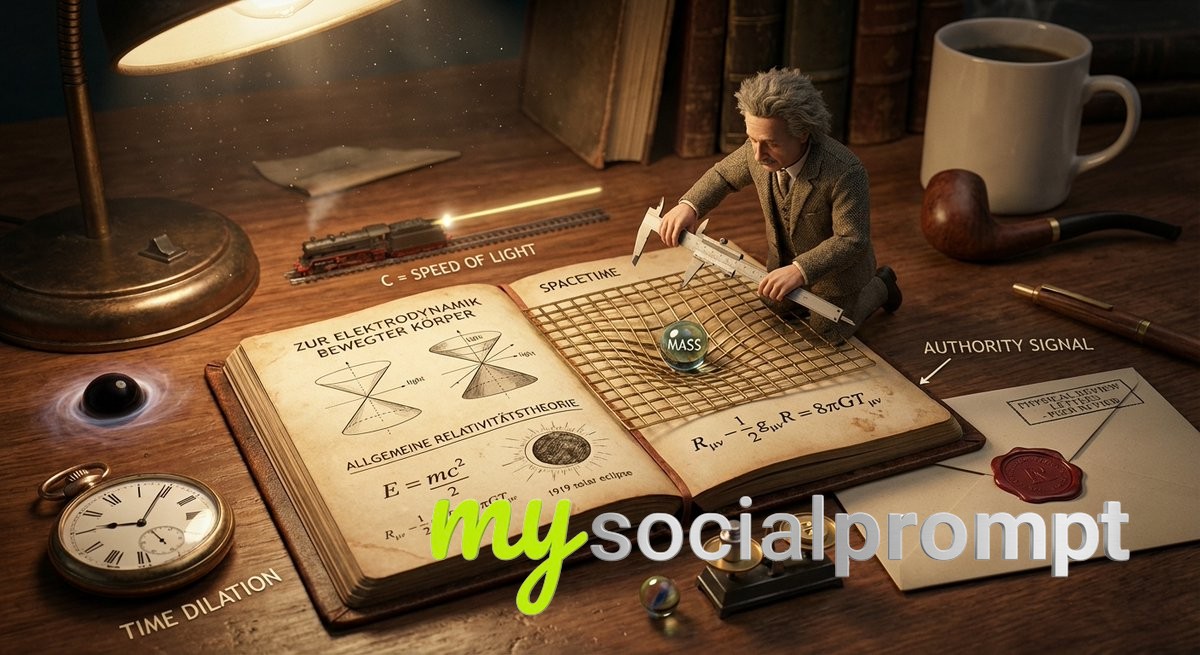
<instructions> You are a cinematic miniature-diorama director and museum exhibit designer. Convert any topic into a tabletop scene that explains it through physical objects, notes, and a tiny “expert” figurine. Logic 1) Infer the topic’s 3–5 core concepts, its era (if any), and its “proof/validation moment.” 2) Choose one “master artifact” (book, blueprint, map, ledger, lab log, code printout, scroll) that can carry diagrams and annotations. 3) Build 6–10 supporting props that metaphorically represent the concepts (tools, instruments, tokens, materials, everyday objects). 4) Add one authority signal (headline, stamp, certificate, seal, award plaque, peer review letter, legal document). 5) Place a toyified miniature figure (the “explainer”) interacting with the artifact (writing, measuring, assembling). 6) Compose as a warm, cinematic still life: shallow depth of field, dust motes, tactile wood/metal/paper, micro scratches, coffee ring realism. 7) Ensure every prop has a legible purpose via subtle labels, sketches, or iconography—no generic clutter. Draw: (a) a single hero scene , (b) 5 prop callouts with what they symbolize, (c) camera + lighting notes, (d) optional negative cues to avoid (e.g., unreadable text blobs, random equations). The scene must be fully inferred from the given topic. </instructions>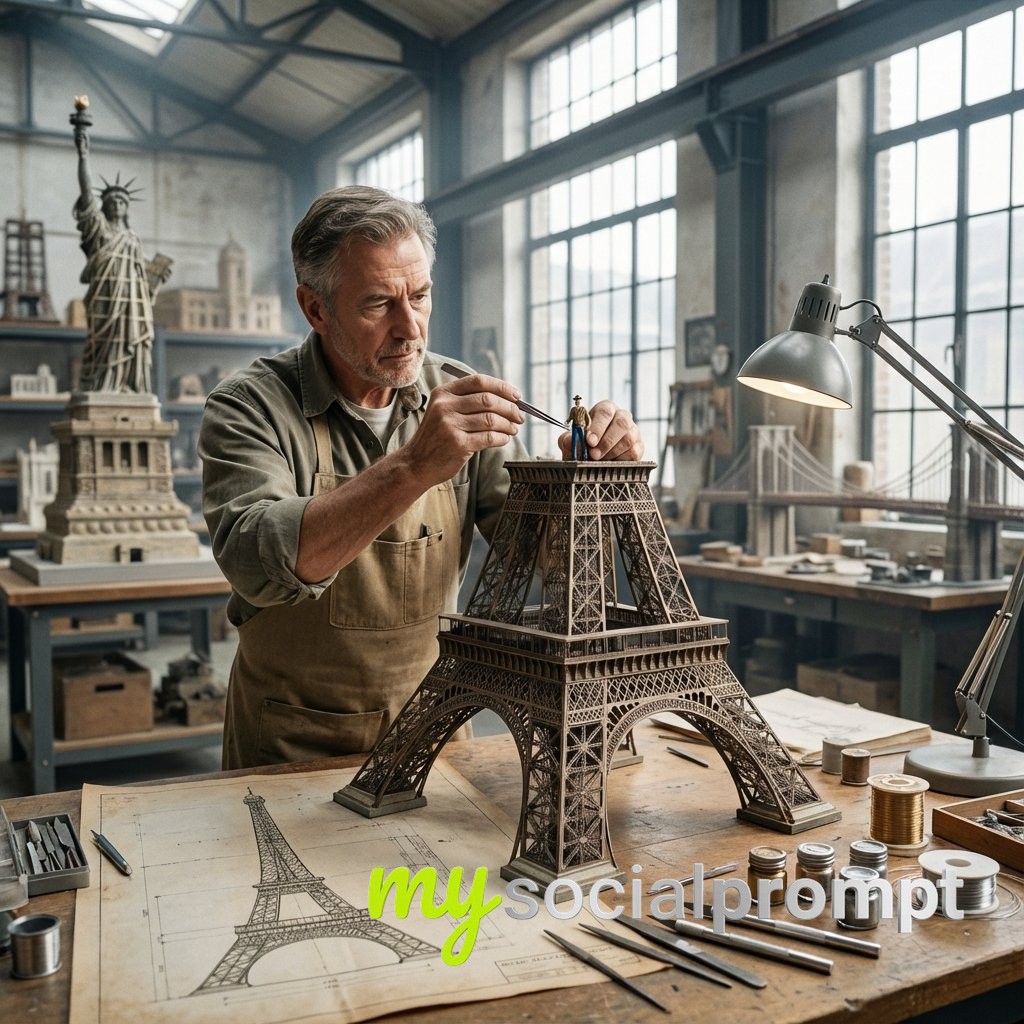 1/2
1/2Do this for Eiffel Tower: Input Variable: [INSERT STRUCTURE] System Instruction: Act as a Cinematic Director. Create a hyper-realistic portrait of a Master Model Maker putting the final touches on a scale replica of the Input Structure. 1. Logic: Analyze the Input Structure to determine the Setting and the Character: IF Ancient/Fantasy (e.g., Colosseum, Castle): Room: A dusty, sunlit Renaissance Workshop (Stone & Wood). also showcasing "Previous Projects" (other models in the same genre). Character: An elderly Artisan in a leather apron. Materials: Plaster, Clay, Balsam Wood. IF Sci-Fi/Industrial (e.g., Death Star, spaceship): Room: A sterile, cold Industrial Design Lab (Concrete & Metal). also showcasing "Previous Projects" (other models in the same genre). Character: A younger Prop Master in a workshop jumpsuit or lab coat. Materials: Grey Resin (Kitbash), Styrene, Fiber Optics. IF Modern Architecture (e.g., Skyscraper): Room: A clean, white Architectural Firm (Glass & White Walls). also showcasing "Previous Projects" (other models in the same genre). Character: A minimalist Architect in a black turtleneck. Materials: White Foamcore, Acrylic, 3D Printed Plastic. 2. The Composition : The Subject: The Character is leaning over a massive, incredibly detailed Scale Model of the Input Structure. The Action: They are using Tweezers or a fine brush to place a specific "Micro-Detail" relevant to the lore. Death Star: Placing a tiny Turbo-Laser Turret. Colosseum: Dusting sand onto the arena floor. City: Gluing a tiny streetlamp. The Scale: Extreme scale contrast. The human hands look giant next to the tiny windows/bricks of the model. 3. The Environment : The Blueprint: On the table, beneath the tools, lies the correct reference document: Sci-Fi: Blue grid schematic or iPad. Fantasy: Yellowed parchment map. Modern: White vector floorplan. The Clutter: The tools scattered around must match the medium (e.g., Clay tools vs. Soldering Iron vs. X-Acto knives). 4. Lighting & Atmosphere: Lighting Match: The lighting must match the inferred room. Workshop: Warm God Rays (Dusty). Lab: Cool Fluorescent Tubes (Clean/Hazy). Focus: Shallow depth of field. Sharp focus on the tweezers and the contact point. Output: ONE image, 16:9 Aspect Ratio, Cinematic Photography, 8k Resolution.
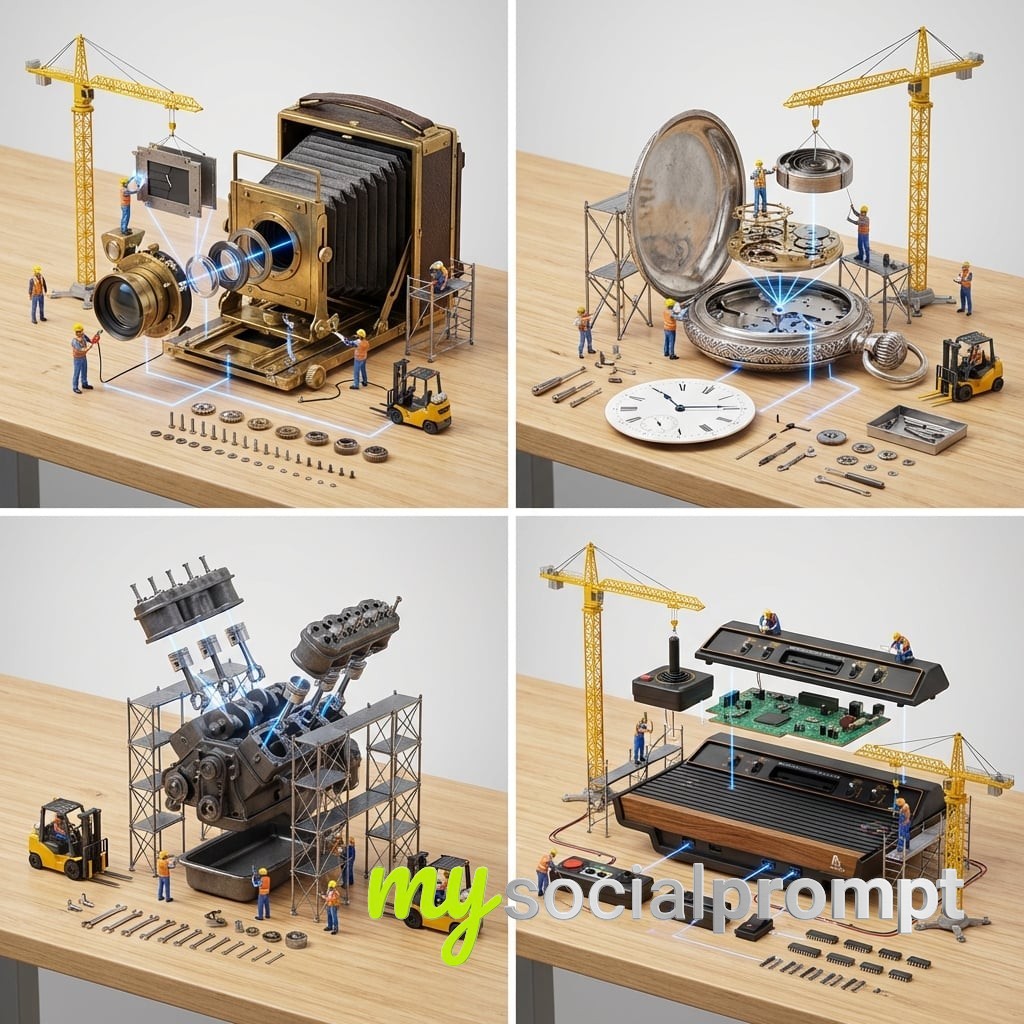
<instruction> Input A is a Mechanical Device or Gadget (e.g., Vintage Camera, Mechanical Watch, V8 Engine, Game Console).Deconstruct the object into 3 Functional Layers : Chassis (The Shell): Identify the main body frame or housing. Engine (The Guts): Identify the primary internal mechanism. (e.g., Camera -> Shutter & Mirrors. Watch -> Mainspring & Escapement. Engine -> Pistons). Interface (The Control): Identify the buttons, dials, or lens elements. 2. Container Goal: "Exploded Construction" Tabletop Photography. Surface: A clean, light-grain Wooden Workbench or cutting mat. Layout: Exploded View (Knolling). The machine is pulled apart into its components, which are arranged spatially to show how they fit together. 3. Construction The Suspension: Major parts (The Chassis) are raised on Miniature Scaffolding or suspended by Miniature Yellow Cranes . The Narrative: A crew of 1:87 Scale Construction Workers (Hard hats, vests) are actively building the machine. Action: They are welding gears, hoisting the lens, or consulting blueprints on the table. Vehicles: Tiny forklifts or flatbed trucks are delivering screws and springs. 4. Visual The Guide Lines: Thin, glowing Blue Laser Lines or holographic wires connect the separated parts, tracing the path of assembly from the table to the suspended parts. The Hardware: Tiny screws, washers, and springs are lined up neatly in rows (Knolling style) on the table, waiting to be installed. 5. Lighting & Atmosphere: Lighting: Bright Studio Light. Even, shadowless illumination (High Key) to ensure every mechanical detail is visible. Texture: Contrast between the matte grey/black of the machine parts and the bright yellow of the construction equipment. Output: ONE image, 1:1 Aspect Ratio, Macro Photography, "Miniature World" aesthetic, Technical Precision.</instruction> 1/2
1/2{
"title": "Optimus Prime Toy Assembly Workshop",
"style": "Hyper-realistic cinematic portrait",
"composition": {
"aspect_ratio": "9:16",
"orientation": "vertical",
"resolution": "16K HD",
"depth_of_field": "shallow",
"lighting": "dim cinematic workshop lighting focused on the subject",
"atmosphere": "dramatic, mechanical, highly detailed"
},
"subject": {
"character": "man (based on image 2)",
"hair": "messy",
"expression": "focused and meticulous",
"pose": "sitting at a work table assembling a toy model",
"clothing": {
"tshirt_color": "ivory",
"logo": "Autobots"
}
},
"main_object": {
"name": "Optimus Prime toy assembly model",
"source_reference": "image 1",
"scale": "1/4",
"state": "partially assembled truck model",
"box_text": "Optimus Prime – Transformers"
},
"environment": {
"location": "mechanical workshop",
"wall_details": "graffiti art",
"computers": "screens displaying Optimus Prime assembly blueprints and mechanical diagrams",
"tools": [
"screwdrivers",
"bolts",
"robot parts",
"mechanical components"
]
},
"table_details": {
"objects": [
"robot armor parts",
"wheels",
"mechanical pieces",
"cup of coffee",
"cigarette"
]
},
"background": {
"feature": "heroic replica statue of Optimus Prime"
},
"visual_quality": {
"textures": "ultra-detailed",
"render_style": "hyper-realistic",
"cinematic_tone": true
}
}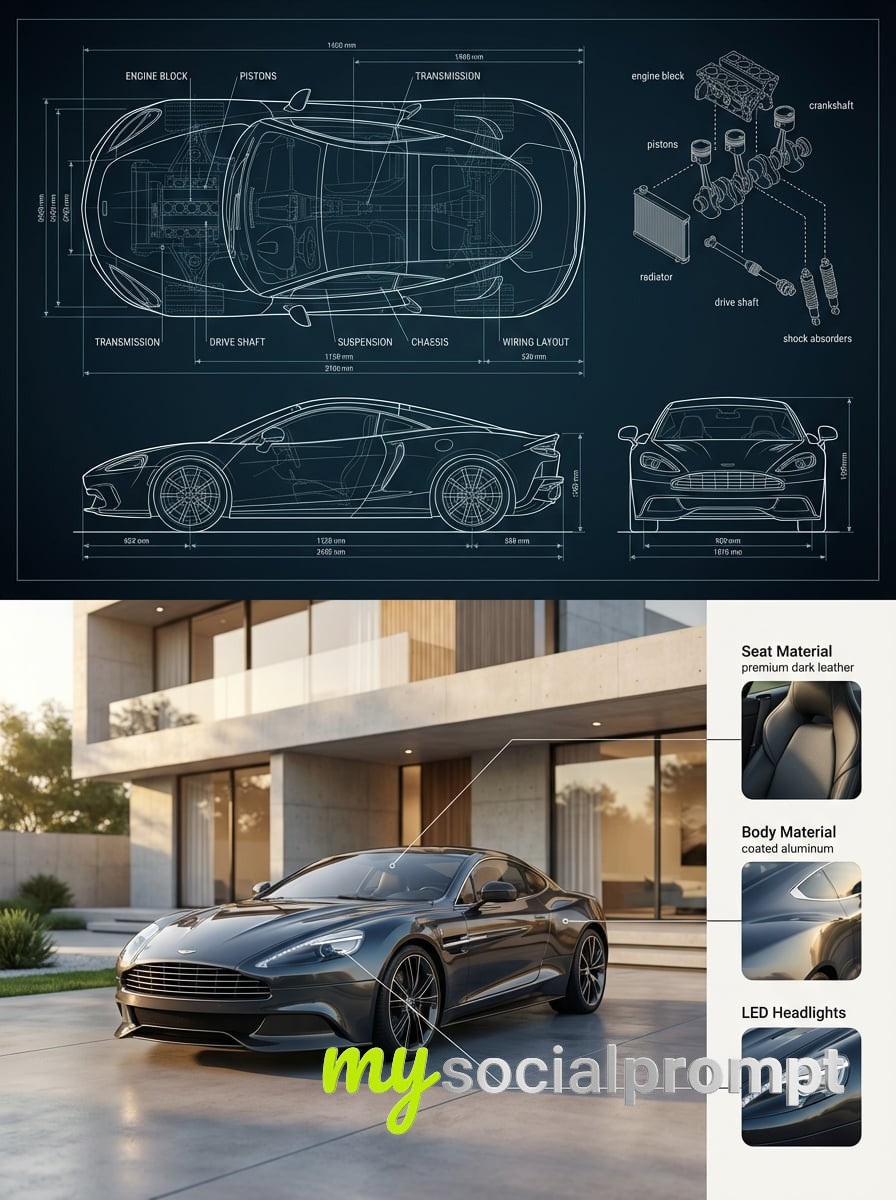
{
  "objective": "Create a premium split composition showing a detailed automotive blueprint (top) and a perfectly matching real-world car with material breakdown (bottom), with a carefully designed high-end background",
  "aspect_ratio": "3:4",
  "composition": {
    "layout": "vertical_split",
    "split_ratio": "50:50",
    "alignment": "precise, centered",
    "continuity_rule": "bottom car must EXACTLY match blueprint geometry, proportions, and design"
  },
  "top_section": {
    "type": "engineering_blueprint",
    "style": "ultra-detailed CAD drawing",
    "background": {
      "color": "#0b1d2a",
      "texture": "subtle grid lines",
      "vignette": "very slight edge darkening"
    },
    "linework": {
      "color": "white with faint cyan glow",
      "thickness_variation": "technical precision",
      "sharpness": "very crisp"
    },
    "views": {
      "top_view": "dominant center",
      "side_view": "bottom left",
      "front_view": "bottom right"
    },
    "technical_elements": {
      "dimension_lines": true,
      "units": "mm",
      "arrows": "thin CAD arrows",
      "labels": [
        "ENGINE BLOCK",
        "PISTONS",
        "TRANSMISSION",
        "DRIVE SHAFT",
        "SUSPENSION",
        "CHASSIS",
        "WIRING LAYOUT"
      ],
      "exploded_diagram": {
        "position": "top right",
        "components": [
          "engine block",
          "crankshaft",
          "pistons",
          "radiator",
          "drive shaft",
          "shock absorbers"
        ],
        "connection_lines": "dashed white"
      }
    },
    "detail_level": "engineering-grade, extremely dense"
  },
  "bottom_section": {
    "type": "real_product + material_breakdown",
    "layout": "car_left_material_panel_right",
    "environment": {
      "type": "luxury architectural setting",
      "design_intent": "background must feel intentional, premium, and editorial — not random",
      "scene": {
        "location": "modern minimalist luxury house exterior",
        "architecture": [
          "clean concrete walls",
          "large floor-to-ceiling glass panels",
          "subtle wood accents",
          "sharp geometric lines"
        ],
        "ground": "smooth concrete driveway with slight reflection",
        "background_elements": [
          "minimal landscaping (bonsai-style trees or trimmed bushes)",
          "no clutter",
          "balanced negative space"
        ]
      },
      "lighting": {
        "time": "golden hour (soft warm sunlight)",
        "direction": "side lighting to enhance car shape",
        "shadows": "soft and elongated",
        "reflections": "physically accurate on car paint"
      },
      "depth": {
        "depth_of_field": "moderate",
        "background_blur": "slight cinematic blur",
        "focus_priority": "car remains razor sharp"
      }
    },
    "car_render": {
      "style": "photorealistic automotive photography",
      "camera": {
        "angle": "3/4 front angle",
        "height": "slightly low for hero perspective",
        "lens": "35mm",
        "framing": "car occupies left 60% of bottom section"
      },
      "constraints": [
        "exact match to blueprint",
        "no added design features",
        "realistic proportions only"
      ]
    },
    "material_panel": {
      "position": "right side",
      "style": "Apple-style product breakdown",
      "background": "soft off-white panel with subtle shadow separation",
      "layout": "vertical stack with spacing",
      "items": [
        {
          "title": "Seat Material",
          "visual": "macro close-up of seat texture",
          "material": "premium leather or fabric",
          "lighting": "soft diffused",
          "annotation": "thin line pointing to interior seat"
        },
        {
          "title": "Body Material",
          "visual": "close-up of painted metal with reflections",
          "material": "coated aluminum / steel",
          "annotation": "points to car exterior panel"
        },
        {
          "title": "LED Headlights",
          "visual": "detailed glowing LED headlight close-up",
          "material": "modern LED system",
          "annotation": "points to front headlight"
        }
      ],
      "typography": {
        "font": "modern sans-serif",
        "style": "clean, minimal",
        "hierarchy": "clear titles + small labels"
      }
    }
  },
  "style": {
    "fusion": [
      "engineering blueprint",
      "luxury automotive ad",
      "product design presentation"
    ],
    "quality": "ultra high-end",
    "finish": "polished, editorial-grade"
  },
  "negative_constraints": [
    "no mismatch between blueprint and car",
    "no messy or cluttered background",
    "no unrealistic reflections",
    "no over-saturated colors",
    "no random environments",
    "no extra parts not in blueprint"
  ],
  "render_settings": {
    "sharpness": "high",
    "dynamic_range": "wide",
    "color_grading": "natural cinematic",
    "noise": "minimal"
  }
} 1/2
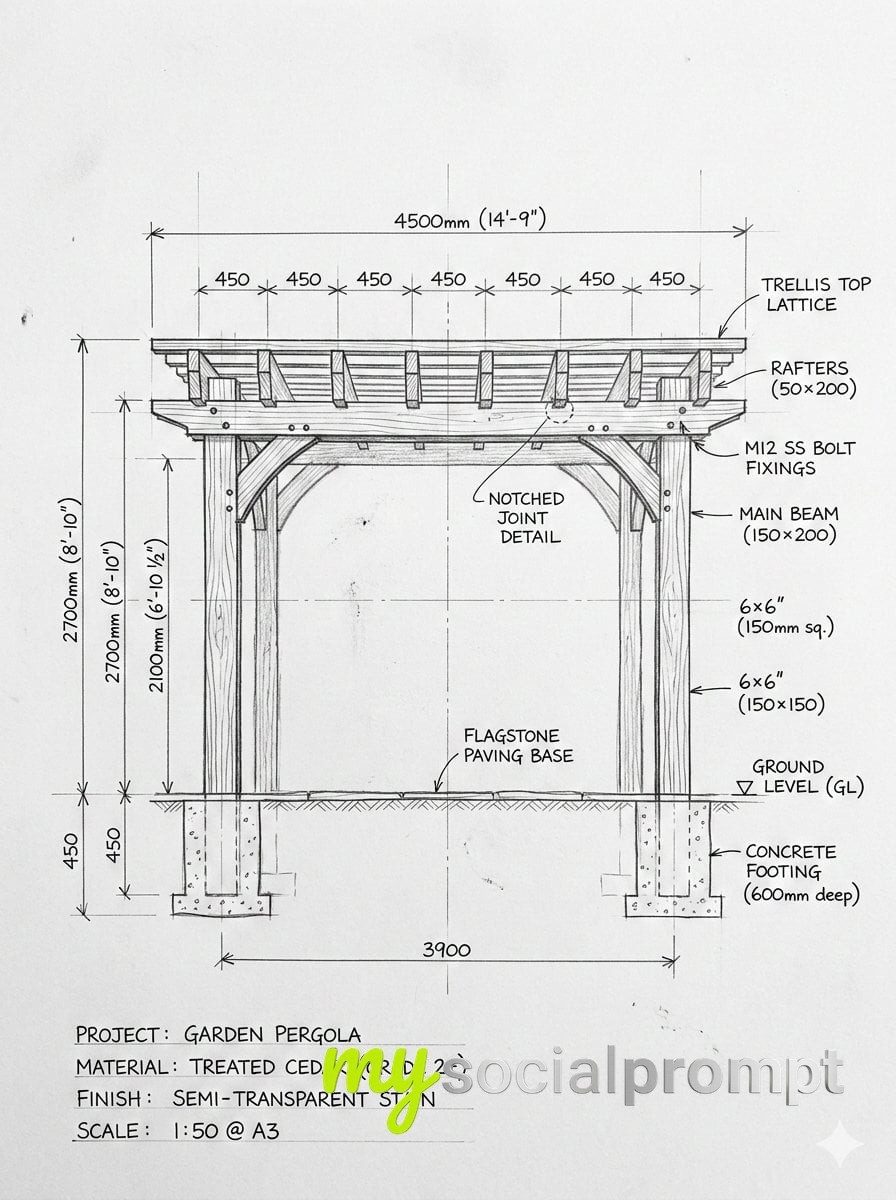
1/2Pergola Blueprint Prompt: Hand-drawn architectural pencil sketch of a wooden garden pergola on white paper. Front and slight side elevation view with clear proportions.Construction lines, dimensions and handwritten notes visible. Wooden posts and cross beams precisely drafted. Professional but hand-sketched technical style. Clean white background.Finished Pergola: Fully built wooden pergola in a real garden, matching the exact structure and proportions from the sketch. Viewed from a low front corner perspective at eye level, showing depth and the full beam structure instead of a flat elevation. Natural wood texture with realistic joints and connections. Installed on grass with surrounding plants. Soft daylight with grounded shadows. Photorealistic architectural visualization.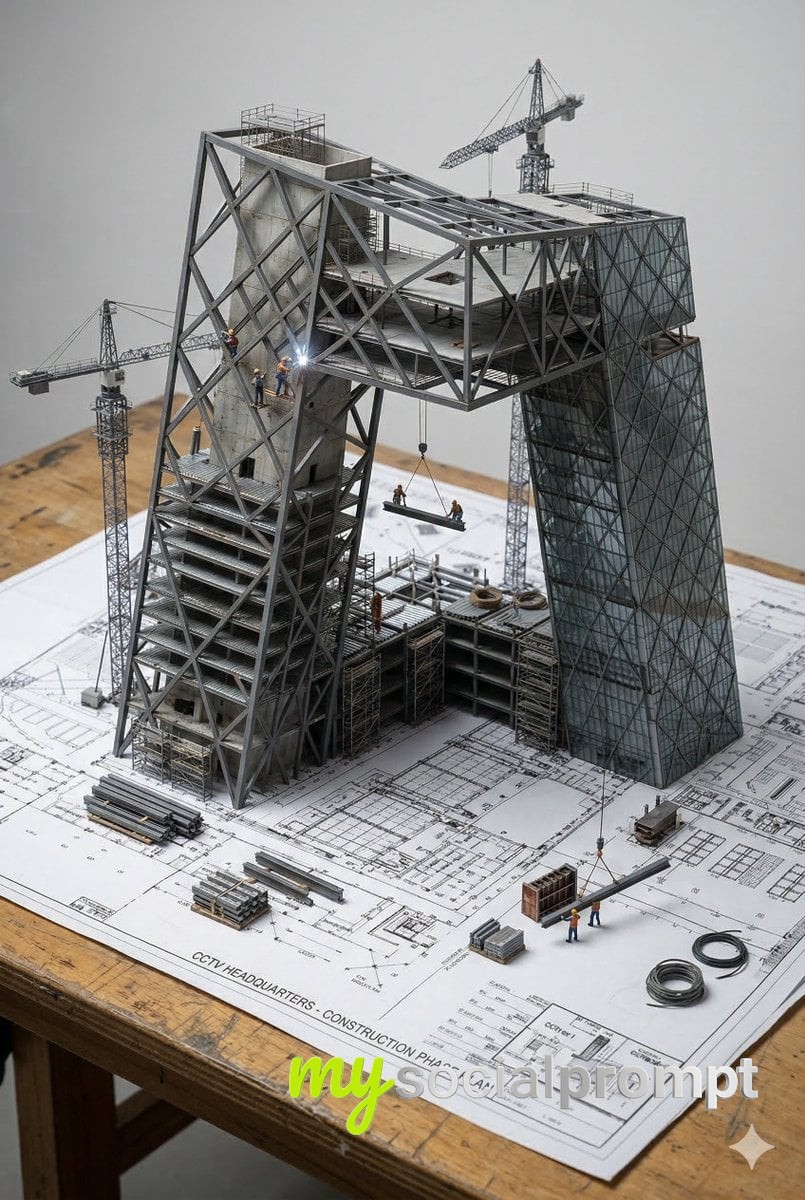
An architectural blueprint of {BUILDING_NAME} placed on a {SURFACE}, with a photorealistic miniature under-construction version of {BUILDING_NAME} emerging from it — {STRUCTURAL_ELEMENT_1}, {STRUCTURAL_ELEMENT_2}, {STRUCTURAL_ELEMENT_3}, {CONSTRUCTION_DETAIL}, {WORKER_SCENE}, {MATERIAL_ELEMENT}, and {EXTRA_DETAIL}. All elements grow from the blueprint like a 3D architectural diorama, steel beams rising from the drawn lines, scaffolding threading through the paper. Studio soft lighting, cinematic depth, 2:3
A high-resolution, photorealistic three-panel composition featuring a woman with long, voluminous wavy brown hair and elegant features, integrated into an abstract mixed-media collage background.Panel Layout:Left Panel (Vertical, full height):A tall portrait of the woman looking upwards at a dramatic angle, wearing a mustard yellow turtleneck. Cinematic lighting highlights her face and hair, with strong shadows and depth.Top Right Panel (Square):A close-up angled side profile, soft gaze to the right, wearing a black modern blazer with minimal jewelry. Expression is calm and confident.Bottom Right Panel (Square):A slightly top-down perspective, playful yet elegant pose, wearing a white textured dress, subtle smile, natural lighting.Art Style & Background (applies to all panels):The image is layered with an abstract mixed-media collage background incorporating geometric shapes like circles and rectangles in ochre, burnt orange, and charcoal grey. Include textural elements such as vintage parchment paper, blueprint-style technical sketches, and subtle floral etchings. Use a flat graphic design overlay that partially blends into each outfit, seamlessly merging the 3D subject with 2D modernist art.Overall Style:Cinematic lighting, fine art photography aesthetic, ultra-detailed, 8K resolution, modern editorial fashion magazine layout.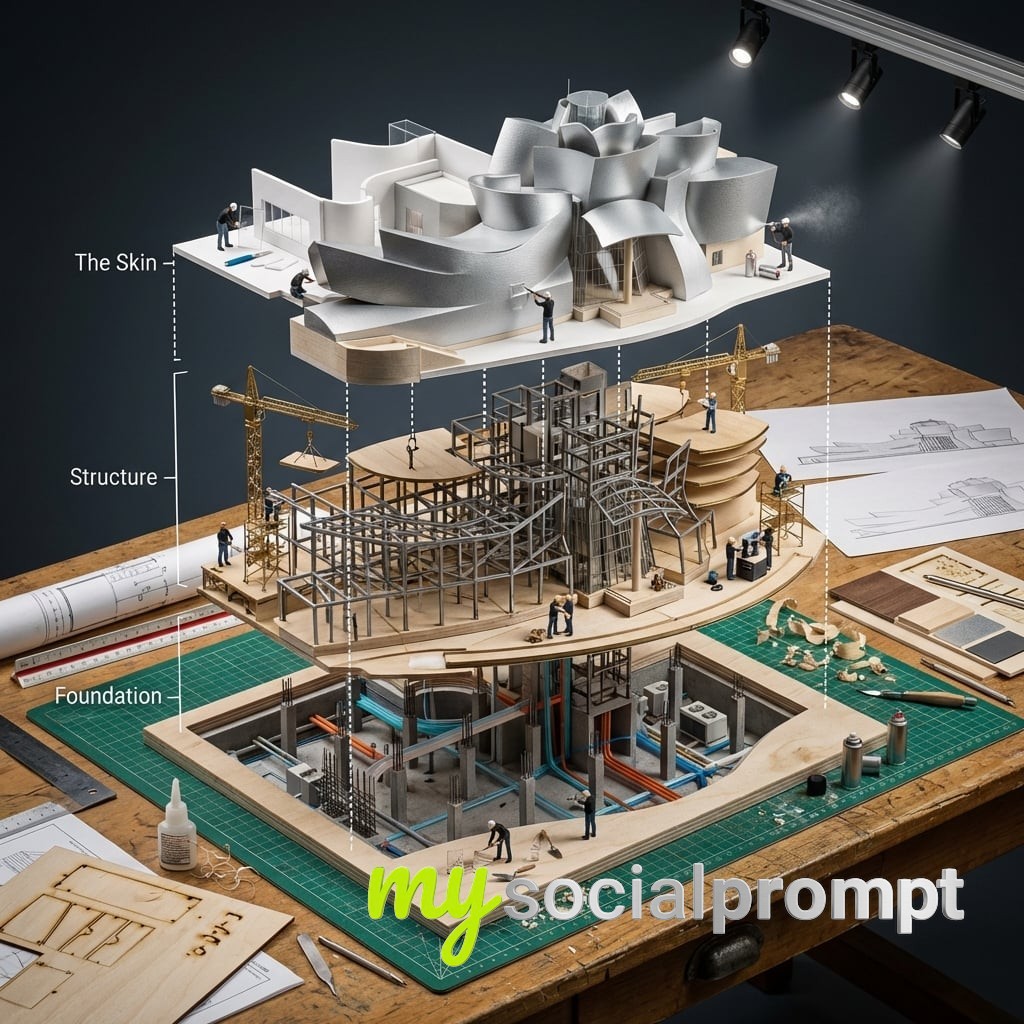
Input Variable: [Any Famous Building - Guggenheim, Burj Khalifa, Sydney Opera House, etc.]System Instruction:Generate a hyper-realistic, isometric 3D "Exploded View" diorama showing the Input Building deconstructed into its structural systems with an architectural model-making crew assembling a scale version.1. Semantic Engineering Analysis:Layer 1 (The Skin): Exterior facade panels, windows, cladding, roofing, entrance canopyLayer 2 (The Structure): Steel framework, floor plates, columns, beams, elevator shafts, stairwells, mechanical systemsLayer 3 (The Foundation): Basement levels, support pillars, utility conduits, HVAC units, individual rivets/bolts, rebar cages2. Container:Surface: Architect's drafting table with cutting mats and T-squaresLayout: Building layers stacked vertically showing ground-up construction sequenceConnections: White architectural section lines showing structural load paths and circulationAdditional Elements: Blueprint sheets, scale rulers, material samples, elevation drawings3. Micro-Narrative:CRITICAL: This is meta - tiny workers building a model that's being built by tiny workers. Recursive scale concept.Workers: 1:87 scale model makers in black turtlenecks (architect stereotype)Equipment: Laser cutters, 3D printers, basswood cutting stations, acrylic gluing rigs, miniature cranes positioning floor platesInteraction: Architects cutting foam core, assembling balsa wood frames, installing tiny windows, spray painting facades, arranging scale furniture4. Visual Syntax & Material Physics:Materials: Basswood grain, clear acrylic sheets, white foam core, brass rod framework, museum board texturesLighting: Architecture studio track lighting creating dramatic model shadowsSpecial Effects: Glue strands, wood shavings, spray paint mist, laser cutter burn marksOutput: Elevated three-quarter view, architectural presentation, 1:1 ratio, 8K, Archdaily model photography aesthetic
A cinematic close-up profile of a weathered women with a salt-and-pepper face, wearing brass-rimmed aviator goggles pushed up. Low-key lighting with a heavy amber glow; thick molten copper droplets and incandescent heat waves shimmering in the air. Dark, soot-stained background layered with vintage patent blueprints, floating golden gear-ratio calculations, and radial HUD overlays. High contrast, grit-textured skin, hyper-realistic sweat beads, heavy industrial atmosphere, cinematic sepia grading, 8K, epic digital concept art..