Weekly AI Digest
Master the AI Revolution
Exclusive prompts, model comparisons & creative techniques — curated weekly for creators and professionals who stay ahead.
No spam. Unsubscribe anytime.
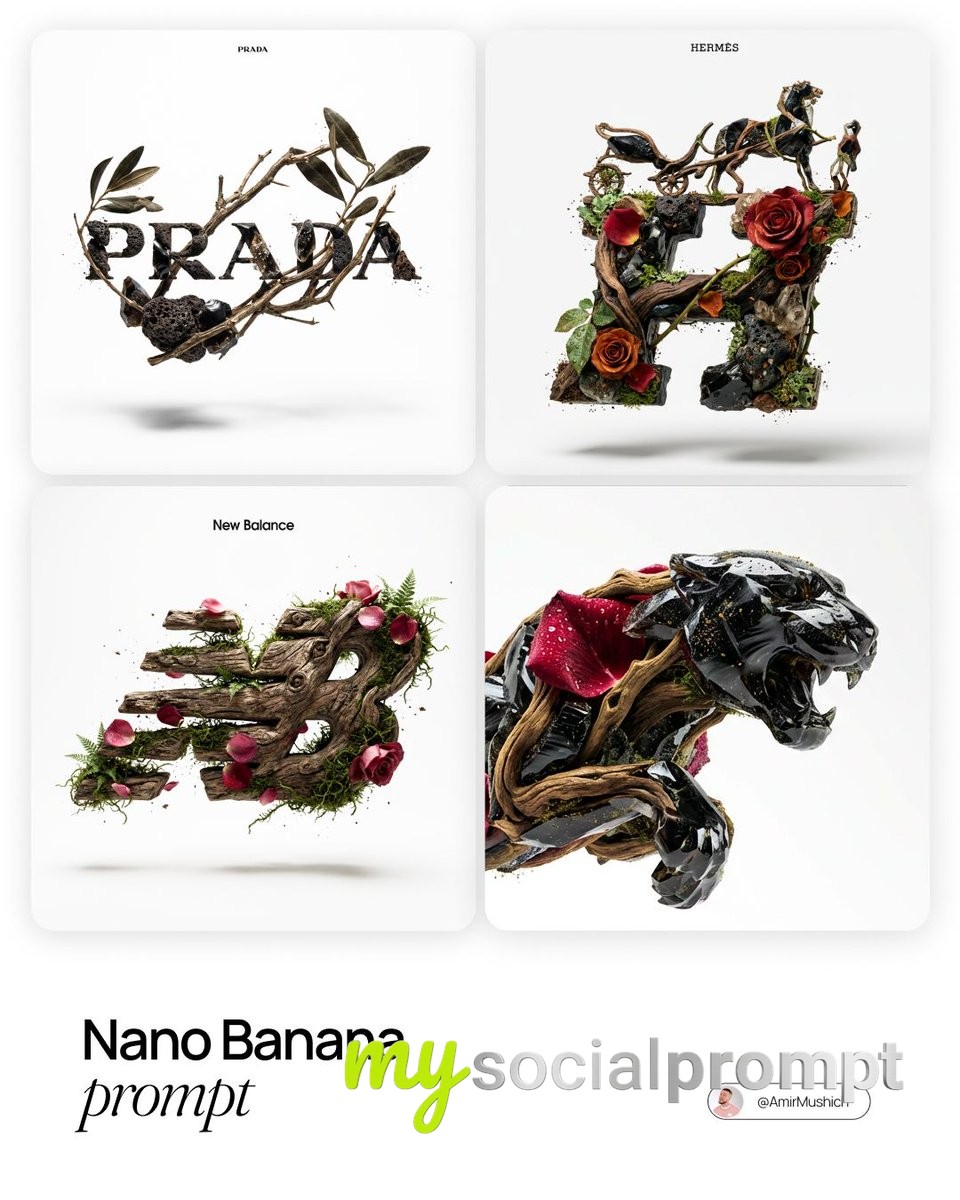
[BRAND NAME]. Act as a Master of Material Science and World-Class 3D Visualizer.PHASE 1: DYNAMIC ELEMENTAL RECONSTRUCTION.The central subject is the iconic logo of [BRAND NAME], physically constructed from ANY raw natural element.CRITICAL: This includes, but is not limited to, botanical elements (flowers, rose petals, thorns, gnarled wood, moss, leaves) and geological/elemental materials (obsidian, crystals, flowing water, ice, volcanic rock).The logo must be medium-sized, levitating, and rotated at a dynamic 3D angle (3/4 view) to showcase its volume.PHASE 2: HYPER-TACTILE TEXTURE & REALISM.The goal is "Sensory Realism" — the viewer should feel they can touch the object.- If BOTANICAL: Render microscopic cellular structures on petals, dew droplets with refraction, and the velvety fuzz on stems.- If MINERAL: Render micro-pores, crystalline inclusions, and razor-sharp edges.Include subtle "imperfections" like dust particles or organic irregularities to break the CG look and achieve 100% photorealism.PHASE 3: COMPOSITION, LIGHTING & BRANDING.- ENVIRONMENT: A pure, clinical, solid white background for a High-Key commercial look.- TYPOGRAPHY: At the top of the frame, place a very small, minimalist [BRAND NAME] text logo in black.- LIGHTING: Precise studio setup with sharp specular highlights (glints) and a soft, realistic contact shadow on the white floor below to ground the levitating object.TECH SPECS:Extreme Macro photography, 100mm lens, f/8, Ray Tracing (Path Tracing), Subsurface Scattering for light depth, 8k resolution, Unreal Engine 5.4 / Octane Render aesthetic.
You've reached the end of the feed